Friday, August 7, 2020

Gary Walker

 In the summer of 1980, I decided to take a year off from law school to restore my health and sanity.  I moved back to Nashville with the loose expectation of a job, which promptly fell through; so, I spent the summer doing everything from scraping paint off houses to projecting Don Evans movies at the Parthenon (those were indeed different times).  At one point, I interviewed for a job in the music business only to discover that it involved hawking Pope Paul II picture discs.  Out of desperation, I applied for a job at the Great Escape, which, in its young history, had already become my go-to used record store.  As I recall, the owner, Gary Walker, told me almost immediately that there were no openings.  Yet, somehow, we got onto the subject of buying and selling rare records and advertising in Goldmine magazine.  Weirdly enough, I had been buying and selling records through Goldmine auctions (as well as other publications) since high school, and what I might have lacked in experience I think I made up for in genuine enthusiasm.  Remarkably, I walked out of the store with the best job of my life.  For the next 14 months, I helped put together the store's massive two-page monthly advertisements in Goldmine, meaning I helped select the records, graded them, wrote the listings (thank God I didn't have to type them), kept track of the bids, sent out the winners' letters, and then cleaned, packed and shipped the discs.  My other job responsibilities included sweeping the store every morning and checking the vintage issues ofPlayboy magazine the store sold to make sure the foldouts were intact.  I was in heaven. The store also gave employees a discount and first crack at the used records that came in. That was dangerous. To this day, I marvel at how  many records in my collection still have the tell-tale Great Escape sticker in the upper right hand corner. 


But my favorite part of the job was getting to know Gary Walker and his family.  Gary had years of experience in the music business.  I learned much of this while working at the store and much more later – and he knew everybody, so you never knew who might show up in the store.  He had such enthusiasm for his job and the enterprise he was growing (the store eventually expanded to four or five different locations).  His enthusiasm was contagious.  And, as I recall, he never wore a watch. I really enjoyed the time I got to spend around him, his wife Peggy and their children Karen and Greg. I’m still friends with Greg (a guy who knows more obscure music trivia than I’ll ever possibly know) today.  


Eventually, I had to leave Nashville again to return to law school, but Gary let me work for him again the following summer while I clerked for a Nashville law firm, and I am proud that years later I got to do some legal work for his record label, Great Escape Records.  When Gary passed away several  weeks ago, I was kind of shocked to read that he was 87 years old.  Chronologically, that made sense, but in my mind, he was much younger. He was someone I was genuinely happy to run into because he was always positive and onto something new and great.  


It is hard to find a good definition of the word “mentor”  that doesn’t sound corny but I just saw the term defined as “anyone who is a positive guiding influence on another person’s life”. Gary probably didn’t know this but he was a very positive influence on my life at a time that I needed a positive influence- and I’m sure I’m not the only person who feels this way. 

Wednesday, June 24, 2020

Lady A v. Lady A

One of my friends, entertainment lawyer Robin Mitchell Joyce, wrote an article for a bar journal probably two  decades ago in which she stated that it was next to impossible to find a good band name that had not already been taken. I think about this all the time and realize that its more true than ever.  This was especially hard in the pre Google era when you had to use expensive search companies to do far flung federal and common law and state searches to try and find out if a particular name was available. Even with the most extreme diligence, one can never be 100% sure that a name is truly available free and clear.

 And now you have the strange case of Lady Antebellum, the country trio who have been active since 2006 but recently decided to shorten their name to LADY A "after much personal reflection, band discussions, prayer and honest conversations with some of our closest black friends and colleagues," according to an article in The New York Times.

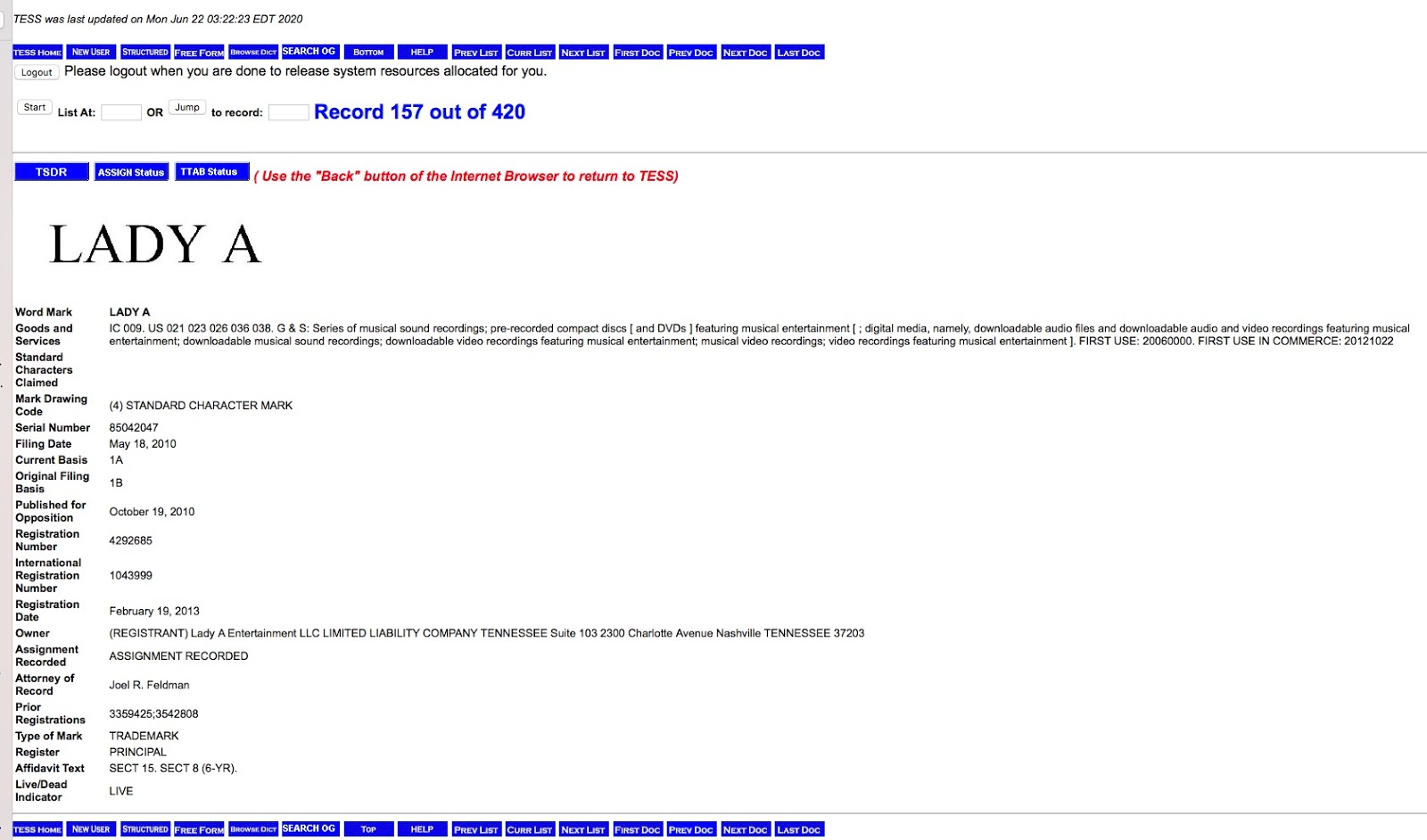
 The only real problem with this is that "Lady A" is also the professional name of a Seattle based blues singer whose real name is Anita White and who has used the name for two decades.  It would seem that a quick Google search would have revealed this troubling fact.  But the plot thickens.  A search of the Patent and Trademark Office records  reveals that the band's corporate entity, Lady A Entertainment LLC (which itself was created on August 30, 2010) owns trademark registrations for the "Lady A" mark going back to 2010 and 2013.  In other words, while the Tennessee trio might not have known about Seattle's Lady A, they conceivably had a good faith belief that they could use the name since they had several registered trademarks in the name going back a decade.

 It is not clear what will happen with Lady A and Lady A.  It looks as if after an exchange of angry words, the parties have somehow agreed to co-exist but this does bring to mind the pitfalls of dealing with trademarks in group names.  Back in the dark ages when I was in law school, we learned that it is  possible to have specific geographical limitations to trademarks,  but that seems to be a quaint notion in the Internet age.  The Trademark Office  does allow owners to co-exist with and allow others to use marks for certain limited purposes, so presumably, that is what will happen here.  I don't think that this is a battle that either Lady A or Lady A wish to fight. There don’t seem to be any great options.

Thursday, April 2, 2020

Check In

To My Clients:

I wanted to take this opportunity to check in with you during this unprecedented time.  Please know that (despite the challenges of being without power for a week early in March due to the tornado) my office is open and I am available to assist you in any way that I can.


These are strange times. People are asking questions about contracts, leases, employment issues, etc. Whatever questions you might have, just let me know.   I may be able to answer your questions outside my areas of specialization. If I don't have the answer, I will try to find out for you.


Again, if I can assist you in any way during this time, please let me know.

All the best, 


Sawnie R. (Trip) Aldredge

Thursday, January 30, 2020

Royalty Statements

            Anybody who has spent anytime at all working with artists and songwriters will have, at one point or another, tried to review  a royalty statement.  For the longest time, these were multi page documents, often impossible to decipher (sometimes intentionally).  It was (and is) important to review these documents carefully because most contracts only give a relatively short amount of time to object to incorrect accounting information.  For example, I once
had a client who had a top 10 single, which wasn't being reported by his publisher because the information had been keyed in incorrectly.  Luckily, that was easy to correct but I would worry if we had waited longer than the objection period in the agreement to  bring this up.

            Today I would  guess that most of this information is being transmitted electronically and I don't know how carefully it is being scrutinized.  These statements are also much less interesting in these days of streaming when countless lines of reporting are being used to tally pennies of income.
 
            This is why it was so intriguing to come upon these pages of royalty statements intended for the songwriters John Lennon and Paul McCartney from Northern Songs in late 1970.  Like so much Beatles ephemera, these pages ended up on an online auction site, but it is fascinating to see the reported earnings for songs like "The Word," "And Your Bird Can Sing," and "It's Only Love" and see references to those exotic foreign  entities such as Toshiba, Leeds Holland, Odeon and Sonora Sweden.  The whole world of international sub publishing was fascinating at that time.  I love this stuff.  It’s a view to history and a reminder that, as old publishers used to say,  music publishing  truly is a penny business.  

Thursday, December 5, 2019

Obama, Higher Ground and the Patent and Trademark Office

Everybody has problems with the Patent and Trademark Office. Even former President Barack Obama has problems with the Patent and Trademark Office.  I read an interesting story recently about how the former president and his wife, Michelle are setting up an entertainment production company.  In the course of organizing the new venture, Higher Ground Productions, they attempted to register a federal trademark for the name Higher Ground Productions.  The Trademark Office refused registration because of an earlier registration for a company known as "Higher Ground Enterprises" owned by Hanisya Massey.

The Trademark Office routinely rejects trademark applications when the examiner believes the marks are too similar and could cause confusion in the marketplace.  This can be extremely frustrating to the trademark practitioner because you cannot always predict when the Trademark Office is going to determine that marks are too similar – often their reasoning is unclear.  But there is no denying that "Higher Ground Productions" and "Higher Ground Enterprises" are pretty darn similar.

There has been some pretty funny reporting on the saga as the parties attempted to negotiate some kind of settlement.  According to the New York Times, at one point Massey requested screen rolls in some of the Obama's forthcoming productions.  However, the dispute appears to have become ugly with the Obamas now seeking cancellation of Massey's trademark on technical grounds based on alleged non–use.  This can occur when a trademark owner can be shown not to be actively using a mark. However,  in my experience there's a pretty low threshold needed in order to prove continued  use. 

 Maybe the Obamas just like the Stevie Wonder song-- but perhaps they should contemplate coming up with a new name…

Tuesday, November 19, 2019

Gimme Some Lovin'

            Sometimes I am  oblivious to the battles being fought by giants in my  own backyard.  I have just  aware of a case that was disposed of in the Middle District of Tennessee involving Willa Dean Parker and the widow of Homer Banks suing, among others, Stevie Winwood, his brother, Muff Winwood (real name "Mervyn" – who knew?) and Spenser Davis over the alleged copyright infringement of the song "Ain't That a Lot of Love" by the Spenser Davis Group's "Gimme Some Lovin".  There are a number of side issues in this case, as there often are, but the facts boil down to the following:

            1.         Willa Dean Parker and Homer Banks wrote "Ain't That a Lot of Love" in 1965.

            2.         The Spenser Davis Group created "Gimme Some Lovin" on April 5, 1966, and began recording it on June 9, 1966. And released it on October 28, 1966. 

            3.         “Ain't That a Lot of Love” was first released in the United Kingdom by Homer Banks on October 7, 1966 (prior to the famous Sam and Dave version). Sam and Dave did not release their version of the song until 1968. 

            In order to prove copyright infringement of a musical composition, the burden is on the Plaintiff to prove that the Defendant had "access" to the work and that the two works are "substantially similar" enough to prove that the second work was copied from the first work.  In this case, access seemed impossible to prove, since the Sam and Dave recording had not been released in England at the time the Spenser Davis Group created their iconic song.

            It seems that Parker and Banks tried to circumvent this by proving that there was an earlier version of the song by David Porter which could have been heard in the United Kingdom.  They also tried to introduce newspaper interviews by Spencer Davis, himself, where he allegedly admitted that "Gimme Some Lovin" was based on "Ain't That A Lot of Love".  The court rejected the articles as inadmissible hearsay ("a statement, other than one made by the declarant while testifying at the trial or hearing offered in evidence to prove the truth of the matter asserted").  Hence, with no proof of access , the Plaintiff's case was thrown out.  There were other fascinating aspects of the case, - like the fact that Universal Music Group was sued as a Defendant, yet it actually had partial ownership of both songs in question and, hence, could not be sued for infringement under settled copyright law.

            It's kind of a strange thing.  I listen to the famous Sam and Dave recording of "Ain't That a Lot of Love" (as well as the Webb Wilder version) and don’t hear any real similarity to "Gimme Some Lovin".  Then I listen to the Homer Banks' version and the famous riff is, in fact, nearly identical. I couldn't find the David Porter version of the song, but Taj Mahal's recording from 1968 utilizes the riff as well.  I don’t know if experts were used in this case to prove that the riff itself could have come from an earlier source, as is often the case.

            The part that I find sad is that this  battle was taking place in 2017, 51 years after the records were first released.  It reminds me of the dispute between the Estate of Randy California and Led Zeppelin over the song "Taurus".  Why didn't the writers take action when the songs were new?  In my cynical moments, I wonder if this is what has become of the music industry and that these type of lawsuits will continue until we have no surviving songwriters of the rock era, just estates suing other estates over ancient riffs. 

Wednesday, October 2, 2019

Come Together: John Lennon and Morris Levy

The 50th anniversary of the release of Abbey Road got me thinking about the most bizarre Beatles related legal battle:  John Lennon's multilayered dispute with the infamous Morris Levy.  Levy was the colorful  and shady music business kingpin whose empire included Roulette Records, the Strawberries Records chain, nightclubs and numerous other enterprises. He was eventually convicted of extortion but was able to escape prison by dying.

 Abbey Road of course starts with Lennon's composition "Come Together," which features the line, "Here come old flat top, he come grooving up slowly".  Levy's publishing company Big 7 Music sued the Beatles' publishing company and Apple Records claiming that the song infringed upon the Chuck Berry classic "You Can't Catch Me," (which contains the line "Here comes a flat top, he was moving up slowly").  Morris Levy had obtained the copyright to the Chuck Berry composition from Alan Freed.  The lawsuit was apparently prepared for trial, witnesses deposed, experts hired, etc. when Lennon and Levy arrived at an ingenious settlement of the case.  Levy would agree to drop the suit if Lennon would  record "You Can't Catch Me," along with two other Big 7 songs for his next album. 

 The idea must have seemed simple to Lennon because he was planning to make his next album a record of covers of great rock and roll songs.  Levy's catalog contained a number of such classics including Lee Dorsey's "Ya Ya" and "Angel Baby" both of which Lennon pledged to record.  Beatle fans know that nothing is simple and it didn't really happen like this.  

 In what should truly become a feature film,  Lennon began the sessions for this album "Rock and Roll" with Phil Spector and there were reports of drug and alcohol fueled drama complete with Spector firing a gun in the studio (a bit of horrific foreshadowing).  Very little was accomplished before Spector abandoned the sessions and absconded with the master tapes.  While Lennon's representatives negotiated with Spector for the return of the tapes Lennon produced an album for Harry Nilsson  and completed his own Walls and Bridges, on which he recorded a charming but insignificant version of "Ya Ya" with his son Julian.  

Apparently Lennon decided to try and salvage the Spector tapes and record additional material for the album in New York.  Because Lennon had technically breached the settlement agreement by not releasing these recordings on his "next" album Levy became a constant presence in his life, flying him, May Pang and Julian to Disney World, taking him and his band to his farm in upstate New York to rehearse and somewhere along the line Levy got the idea that Lennon had given  him the right to sell the forthcoming record through television mail order advertising ("operators are standing by") on his ADAM VII label.  The facts are befuddling and common sense would indicate to  any rational person that the Beatles' exclusive agreement with EMI would prohibit a third party from releasing  any solo Beatle recordings but Morris Levy was not any typical record company owner.  Apparently Allen  Klein is involved in the story too and may have added fuel to the fire.  Unbelievably, Morris Levy took a rough mix of the recordings which Lennon had given him, slapped an out of date 1968 photograph of Lennon on the cover and began selling Roots:  John Lennon Sings the Great Rock and Roll Hits.  This of course to led to Capitol Records rush  releasing the Rock and Roll album,  Capitol and Lennon both suing Levy and Levy suing Capitol, Lennon and everybody else he could think of.  The reporting of the trial, brilliantly captured in Stan Soocher's book Baby You're  A Rich Man:  Suing the Beatles for Fun and Profit is fascinating, showing a side to Lennon rarely captured.  At the end of it all, the trial judge ruled that Lennon had in fact breached his original settlement agreement with Levy by not releasing "Angel Baby"  (it was posthumously released) but Levy  was enjoined from distributing  Roots,  Lennon was awarded damages for Levy's damage to his reputation from releasing substandard product and Capitol Records was awarded damages for lost profits.  

The Roots album has gone on to become one of the holy grails of Beatles collecting.  Originals are hard to find although counterfeit copies are somewhat easier to locate.  


The irony of all this is that I don’t think Levy would have prevailed in his original  lawsuit. Although the statutory defense to infringement known as  fair use was not codified as a at the time of the original 1970 litigation (it was added in the Copyright Act of 1976) it was still a viable defense and one could argue that Lennon's quote of a single line from a Chuck Berry song in his  song "Come Together" was not in fact copyright infringement.  Most of the case law (at least the case law prior to the "Blurred Lines" decision and the recent Katy Perry decision) would tend to support this theory.  On the other hand, Lennon's idea to simply record a handful of Levy songs to make the lawsuit go away makes a lot of sense.  Perhaps he was also thinking about what his former band mate George Harrison was about to endure with the "My Sweet Lord/He's So Fine" litigation.  But those are different songs and different stories.