Thursday, March 2, 2023

CHAUCER BEATS THE RAP!

I have been meaning to write something about this story since I first read about it in The New York Times last fall but since this news was first reported in 1380, I guess I'm not all that late.


In 1873, a court document was discovered from the year 1380 in which a woman named Cecila Chaumpaigne "released" Geoffrey Chaucer from "all manner of actions related to my raptus".  According to the Times, scholars assumed for years that Chaucer had been accused of rape by Chaumpaigne and had somehow settled the case (something they didn't teach this English major).


New research suggests that the word "raptus" used in this context did not mean rape or assault at all but that this release arose out of a labor dispute where a gentleman named Staunton had accused Ms. Chaumpaigne of leaving his employment and going to work for Chaucer unlawfully.  In the ensuing litigation, it was necessary for Chaumpaigne to release Chaucer from liability. 


There  has been a strain of literary criticism developed over the years that labeled Chaucer a rapist (as well as being racist and anti-Semitic). Full disclosure- I found The Canterbury Tales  almost incomprehensible (although I did like The Wife of Bath). One really has to think about the years of critical theory  which may be premised upon a misunderstanding or faulty translation of a single word.  But the case involves so much more   than that; as the article explains, this work in attempting to vindicate  Chaucer as an individual has been going on for decades and involved a deep dive into ancient legal documents.  To me, it is amazing that these documents still survive in England and could be traced to Geoffrey Chaucer. I’ll have to think about that the next time someone asks me to dig out a contract or case file from the 1980’s. 

Tuesday, February 14, 2023

Lennon, The Mobster and the Lawyer

have been meaning to write a blog about the book Lennon, the Mobster and the Lawyer by Jay Bergen since I saw the author speak here in Nashville last year.  As an obsessive Beatles fan, I find that one of the most interesting chapters in John Lennon's life concerns his convoluted involvement with Morris Levy.


To recap, Levy, the notorious mobster who had far-reaching connections in the music business (owning among other entities, Roulette Records, Birdland and the Strawberries record store chains, as well as numerous publishing companies) sued Lennon for copyright infringement for "borrowing" a bit of Chuck Berry's "You Can't Catch Me" in the song "Come Together".  (As an aside, I always wondered if that claim would have had any chance of success at trial).


Lennon did not want to litigate the case, and as a settlement, he offered to record several of Levy's other copyrights on an upcoming oldies album he was planning to record with Phil Spector.  Spector proved difficult to work with and eventually absconded with the master tapes, and Lennon had no choice but to delay the album while he finished a new album, Walls and Bridges (which included a bit of a Levy copyright ("Ya Ya ") but in an incomplete version. Levy was apparently not happy.  


Lennon and Capitol Records eventually retrieved the tapes from Spector, and Lennon began to arduously rework and finalize the recording Spector had started.  Without spoiling the plot, Levy decided he could somehow market the recording (sourced from an unfinished reel-to-reel tape Lennon had given him) as a sold-on-television-only album – which he did – despite the fact that Lennon was unquestionably signed exclusively  to Capitol Records as a recording artist.  The saga of the Roots album, John Lennon Sings the Great Rock & Roll Hits, with its cheap incongruous photo of White Album period Lennon on the cover, continues to perplex Beatles fans to this day.  


We know that lawsuits commenced immediately with Levy's company suing Lennon, Apple Records, Capitol Records, Lennon's attorney, Harold Seider, etc.   Lennon, Capitol and Apple filed counterclaims.  This book is the story of the ensuing  trial.  From a lawyer's perspective, Bergen's work is fascinating.  He describes the missteps made by Levy's counsel and  the importance of educating the judge as to why Lennon's claims of damage to his career were significant.  The parts where Bergen quotes directly from trial transcripts are amazing.   We also learn that Dave Marsh  was an expert witness for Lennon. The only complaint I have with the book is Bergen's re-creating dialog between Lennon and himself – although, in hindsight, this may have been the only way to convey Lennon's state of mind at the time.  It's interesting to see how Lennon was so engaged in every aspect of the trial.  It is also fascinating  to learn more about Morris Levy, one of the most  colorful characters in the music business.  (I still need to read Tommy James' book about his dealings with Levy).  I'm pleased  that Jay Bergen got to tell this story and I recommend it to both Beatles fans and courtroom drama enthusiasts.

Wednesday, March 9, 2022

Let Us Now Praise David Jacobs

 I recently finished reading Darryl H. Bullock's entertaining book The Velvet Mafia.  The subtitle pretty much explains the whole premise: The Gay Men Who Made The Swinging Sixties.  The book  presents a detailed portrait of some people I know a lot about – Larry Parnes, Brian Epstein, Sir Joseph Lockwood, Joe Orton and Joe Meek as well as people I knew a little bit about including Robert Stigwood, Lionel Bart and the infamous Lord Boothby.  All of these players were instrumental in the British entertainment industry of the 1960s and, coincidentally, they were all gay.


The character who fascinated me the most is David Jacobs, the solicitor to the stars.  At one point he had offices in both London and Hollywood.  He had both The Beatles and Brian Epstein as clients as well as Winston Churchill's daughter, Judy Garland, Diana Dors, Shirley Bassey and John Profumo.  At one point he sued the Daily Mirror for libel on behalf of Liberace, for implying that Liberace was homosexual – and won!  He apparently was known to appear in court in full makeup.


Tragically, Jacobs died a sad death  – found hanging in his garage.  The book questions whether his death was a drug induced suicide or something far more sinister.


I found the story of David Jacobs positively inspiring in some ways.  One doesn't hear about entertainment lawyers being as interesting as their clients.  The idea that Jacobs could be negotiating major deals for Brian Epstein one minute and getting a famous politician’s daughter out of the jail the next makes most contemporary law practices  seem positively dull. 


It’s a fascinating book and gives a lot of deep background into the entertainment business in London before and during the British Invasion. I have only one criticism. In an otherwise well written work, I came across  the worst sentence I think I've ever read:  "According to the inquiry, Halliwell used a hammer to strike Orton, whom he had met at RADA,  on his head at least nine times."

Thursday, October 14, 2021

Online Legal Research back in the Day

 I was leafing through the SMU Law School alumni magazine when I came upon this photograph of the school's first online computer research terminal from Lexis. This is the exact machine we learned to do legal research on in my first year of law school. It took hours. No wonder I preferred to use the books. I still do, although I have to admit online legal research has become a lot easier. 

Monday, May 24, 2021

Co-Writing, Works Made for Hire and Happy Birthday Bob

(collage by Gwil Owen)

 It's Bob Dylan's 80th birthday, and I wanted to mark the occasion by reviewing the complaint in one of the strangest lawsuits I have seen in some time. 

 Late last year, it was announced that Bob Dylan had sold his catalog (including the writer's share of income) to Universal Music Publishing Group for approximately $300 million, one of the highlights in  the recent frenzy of catalog acquisitions.  Shortly thereafter, on January 20, 2021, Claudia Levy, the widow of songwriter/psychoanalyst/theater director Jacques Levy, filed suit against Dylan and Universal for breach of contract, alleging that the Levy estate was somehow due some part of the proceeds that Dylan received from the sale because of the fact that Levy co-wrote ten songs with Dylan, including the majority of the songs on Desire ("Isis" is a personal favorite).


None of that is surprising; contractual disputes occur all the time.  What intrigued me is that Dylan's co-writing arrangement with Levy was a "work made for hire" agreement where Dylan not only owned Levy's share of the copyright, but that for copyright purposes, Levy was Dylan's employee – with no ability to ever recapture his share of the copyright.  Even more surprising is the fact that the contract specified that Levy would receive only 35 percent of the writer’s share of income from the songs, rather than the traditional 50/50 co-writer's share.


  The complaint goes on to list a litany of complaints against Dylan and his associates, but I remain most fascinated by the whole work-made-for-hire concept.  It seems so foreign to any traditional notion of co-writing – although the history of the music business is full of examples of artists and performers making "unique" deals with their collaborators – this one is fairly new to me.  Oddly, Dylan's Motion to Dismiss the claim, which was filed in March, refers to the work-made-for-hire arrangement as "standard." Maybe these deals made more sense back in 1975.  I wonder if he had a similar arrangement with Sam Shepard? I will say that I agree with Dylan's attorneys that the complaint is without merit – the contract clearly gave Dylan the right to assign the copyrights and the deal doesn’t disturb Levy’s continued income stream.  It doesn't look as if the court has ruled on the. Motion  yet.  


 Anyway, happy birthday, Bob.  We're lucky to be living in the same time as you.  


Thursday, March 18, 2021

The Boss Approves

 I have neglected my little blog for a while now.  It looks like I only posted seven times in 2020.  It's not like I had anything else going on. 


 Seriously, this was not intentional.  I have several things I really want to delve into and hope to get them up soon.


  However, I did want to mention how cool it is that Bruce Springsteen has his own radio show, From His House To Yours on Sirius XM.  I have been a fan of Springsteen's since before he was the Boss, and I have known since the first time I saw the E Street Band live that he has excellent taste in covers.  So I was thrilled to find out that last November, he played Jeffrey Foskett's version of "Cool and Gone," written by my compadres Bill Lloyd and David Surface (originally recorded by Bill on his Standing on the Shoulders of Giants album).


 Then on March 11, 2021, Bruce opened the show with the great Bobby Sutliff and his song "Kings of Flannel" followed a little later by Bobby and Tim Lee's band The Windbreakers doing "Girl from Washington," a song I've had stuck in my head since the first time I heard it.  This was followed a little later by Webb Wilder and his recording "Battle of the Bands".


How cool is that? I count all of these guys as clients and friends, and there is something really significant about their music getting acknowledgement from the Boss.  These are all great songs and great artists.  Check them out.


Wednesday, November 25, 2020

GRATITUDE


 This being Thanksgiving, I see a lot of commentators reflecting on the concept of gratitude, especially in this strange (and let's face it, awful) year.  It seems weird to ponder gratitude while there is so much suffering.  However, I feel it.  My wife and I just celebrated one of those milestones of parenthood when our daughter graduated from college.  She had a rough start to her college career, through no fault of her own, and to see her bounce back and finish strong (cum laude – dad brag) fills me with pride and yes, gratitude.  


            I've also been thinking this week about a conversation I recently had with a  client.  She thanked me for some advice I gave her, probably 25 or more years ago, when she was a young songwriter just starting out.  She had been offered a deal with a company I knew to be less than reputable, and I advised her to pass on the offer.  I didn't hear from her for some time after that, but when I started working with her again on some new matters, she reminded me of that first consultation and how she appreciated the counsel.  I was genuinely thrilled to hear that.  Lawyers try hard to make a positive difference in their clients' lives, and when one can actually see tangible proof of that effort and acknowledgement, there's no better feeling.  So my Thanksgiving wish for everyone, to paraphrase writer, Brene Brown, is to "Stop and celebrate one another and our victories … we need to celebrate our accomplishments right now".  I can think of no better way to end 2020.


Or to quote Paul McCartney: https://tinyurl.com/y68g4lfz

Wednesday, October 28, 2020

The Go-Go's Documentary


 I watched  the Go-Go's documentary on Showtime a month or so ago and I have been thinking about it ever since.   I know anecdotally that the film left out a lot.  I have even written about the group's dysfunction before https://tinyurl.com/y4e3p7f4.

Nonetheless this is an intensely watchable film and the early punk footage of the band is fascinating.


Ultimately the Go-Go's documentary serves as an unpleasant reminder of the music business as it existed in the 1980s.  I have very little nostalgia for those days.


The film is pretty honest in recounting the group’s history.  They ruthlessly fired two early members.  In one case they made their manager fire the bass player (reminiscent of the Beatles making Brian Epstein fire Pete Best).  They the forced their  manager, Ginger Canzoneri (who had shepherded them from the L.A. punk clubs to a No. 1 album) to seek more "experienced" managers to the point where she just resigned.  Finally, original member Jane Wiedlin quit the band rather than being forced to share her publishing with the non-writing members of the group.  Plus, there are drug problems, health problems and three really great albums.


I bring all of this up to make a point.  The issue with songwriting is serious and it can break up even the sturdiest group. Wiedlin says in the documentary the  new managers came to the group after they had completed their third album and tried to force them to sign an agreement to split publishing.  This was a huge mistake.  The time to discuss these type of issues is before a band records their first album.  Of course, this is easier said than done.  No group wants to sit in a room and discuss partnership agreements and music publishing splits, but I think it is really critical.  You can trace so many band breakups  back to music publishing disputes.  Lennon and McCartney were wise to cut their bandmates in on the publishing (albeit with minority shares) but songwriting and publishing were among the myriad of issues which helped break up that band.


I am glad that the Go-Go’s got past all of that and continue to perform today and I hope that this documentary can serve not only as a testament to a groundbreaking rock band but also serve as a lesson in band dynamics, loyalty and  diplomacy. 


Friday, September 25, 2020

Adventures In Dry-Cleaning

 I recently read  about the so called, "pants lawsuit", Pearson v. Chung, in which an administrative law judge sued a dry cleaner for $67, 000,000.00 over allegedly losing a pair of slacks.  The case dragged on for years before Pearson lost both at trial and on appeal.  Before it was all over though the dry cleaner had to close his  business and incurred almost $100,000.00 in legal fees (which were recovered thanks to several fund raisers).  

The case led to the District of Columbia Board of  Professional Responsibility seeking to suspend Pearson's law license for engaging in


frivolous litigation.  


Although I was unaware of this infamous case, I have a lot of sympathy for the dry cleaner because it reminded me of one of my favorite clients,  the late Phil Efron owner of Nashville's Douglas Corner Cleaners and Entertainer Wardrobe Services (which was next door to the equally famous Douglas Corner which just closed).  I could write an entire chapter on how I met Phil Efron but when he opened his dry cleaners, we worked out a barter system – I traded legal services for dry cleaning.


This led to some interesting adventures.  Phil had been a dry cleaner in Las Vegas and had actually worked for Elvis Presley at one point.  He was the guy who made those scarves that the King threw out to his fans.  At some point, Phil decided to sell replicas of the scarves in various collector's magazines.  I remember his ad ran something like, "We made them for Elvis now we'll make them for you".  Inevitably, Phil received  the cease and desist letter from the Estate of Elvis Presley.  Phil asked me to deal with the estate's lawyer on his behalf.  I researched everything I could about the right of publicity, First Amendment law, etc. and called E.P.'s lawyer.  He was very amiable and polite but after I finished my spiel , he basically said, "We represent Elvis Presley and we will sue your client into the ground…thank you very much.”  Phil stopped selling the scarves, although I know I have one around here somewhere.  


Our second case was more successful.  Phil had been sued by a bride to be  who claimed that the dry cleaner had shrunk her wedding dress.  The case went to court.  It didn't help that my former law partner's cousin showed up as a witness for the plaintiff.  However, we had an expert witness, the  head of the Tennessee Association of Dry Cleaners who testified that it is essentially impossible to shrink a garment in only one specific area – in this case the waist.  I wisely resisted the urge to demand that the plaintiff try on the garment.  We won; the case was dismissed. 


 I did a lot of other work for Phil and was sorry that he decided to sell the business, but it had taken a toll on him.  I gained a healthy respect for the job these people do and the level of service that they must provide on a daily basis.  I miss Phil. I also miss those freshly ironed shirts.  

Friday, August 7, 2020

Gary Walker

 In the summer of 1980, I decided to take a year off from law school to restore my health and sanity.  I moved back to Nashville with the loose expectation of a job, which promptly fell through; so, I spent the summer doing everything from scraping paint off houses to projecting Don Evans movies at the Parthenon (those were indeed different times).  At one point, I interviewed for a job in the music business only to discover that it involved hawking Pope Paul II picture discs.  Out of desperation, I applied for a job at the Great Escape, which, in its young history, had already become my go-to used record store.  As I recall, the owner, Gary Walker, told me almost immediately that there were no openings.  Yet, somehow, we got onto the subject of buying and selling rare records and advertising in Goldmine magazine.  Weirdly enough, I had been buying and selling records through Goldmine auctions (as well as other publications) since high school, and what I might have lacked in experience I think I made up for in genuine enthusiasm.  Remarkably, I walked out of the store with the best job of my life.  For the next 14 months, I helped put together the store's massive two-page monthly advertisements in Goldmine, meaning I helped select the records, graded them, wrote the listings (thank God I didn't have to type them), kept track of the bids, sent out the winners' letters, and then cleaned, packed and shipped the discs.  My other job responsibilities included sweeping the store every morning and checking the vintage issues ofPlayboy magazine the store sold to make sure the foldouts were intact.  I was in heaven. The store also gave employees a discount and first crack at the used records that came in. That was dangerous. To this day, I marvel at how  many records in my collection still have the tell-tale Great Escape sticker in the upper right hand corner. 


But my favorite part of the job was getting to know Gary Walker and his family.  Gary had years of experience in the music business.  I learned much of this while working at the store and much more later – and he knew everybody, so you never knew who might show up in the store.  He had such enthusiasm for his job and the enterprise he was growing (the store eventually expanded to four or five different locations).  His enthusiasm was contagious.  And, as I recall, he never wore a watch. I really enjoyed the time I got to spend around him, his wife Peggy and their children Karen and Greg. I’m still friends with Greg (a guy who knows more obscure music trivia than I’ll ever possibly know) today.  


Eventually, I had to leave Nashville again to return to law school, but Gary let me work for him again the following summer while I clerked for a Nashville law firm, and I am proud that years later I got to do some legal work for his record label, Great Escape Records.  When Gary passed away several  weeks ago, I was kind of shocked to read that he was 87 years old.  Chronologically, that made sense, but in my mind, he was much younger. He was someone I was genuinely happy to run into because he was always positive and onto something new and great.  


It is hard to find a good definition of the word “mentor”  that doesn’t sound corny but I just saw the term defined as “anyone who is a positive guiding influence on another person’s life”. Gary probably didn’t know this but he was a very positive influence on my life at a time that I needed a positive influence- and I’m sure I’m not the only person who feels this way. 

Wednesday, June 24, 2020

Lady A v. Lady A

One of my friends, entertainment lawyer Robin Mitchell Joyce, wrote an article for a bar journal probably two  decades ago in which she stated that it was next to impossible to find a good band name that had not already been taken. I think about this all the time and realize that its more true than ever.  This was especially hard in the pre Google era when you had to use expensive search companies to do far flung federal and common law and state searches to try and find out if a particular name was available. Even with the most extreme diligence, one can never be 100% sure that a name is truly available free and clear.

 And now you have the strange case of Lady Antebellum, the country trio who have been active since 2006 but recently decided to shorten their name to LADY A "after much personal reflection, band discussions, prayer and honest conversations with some of our closest black friends and colleagues," according to an article in The New York Times.

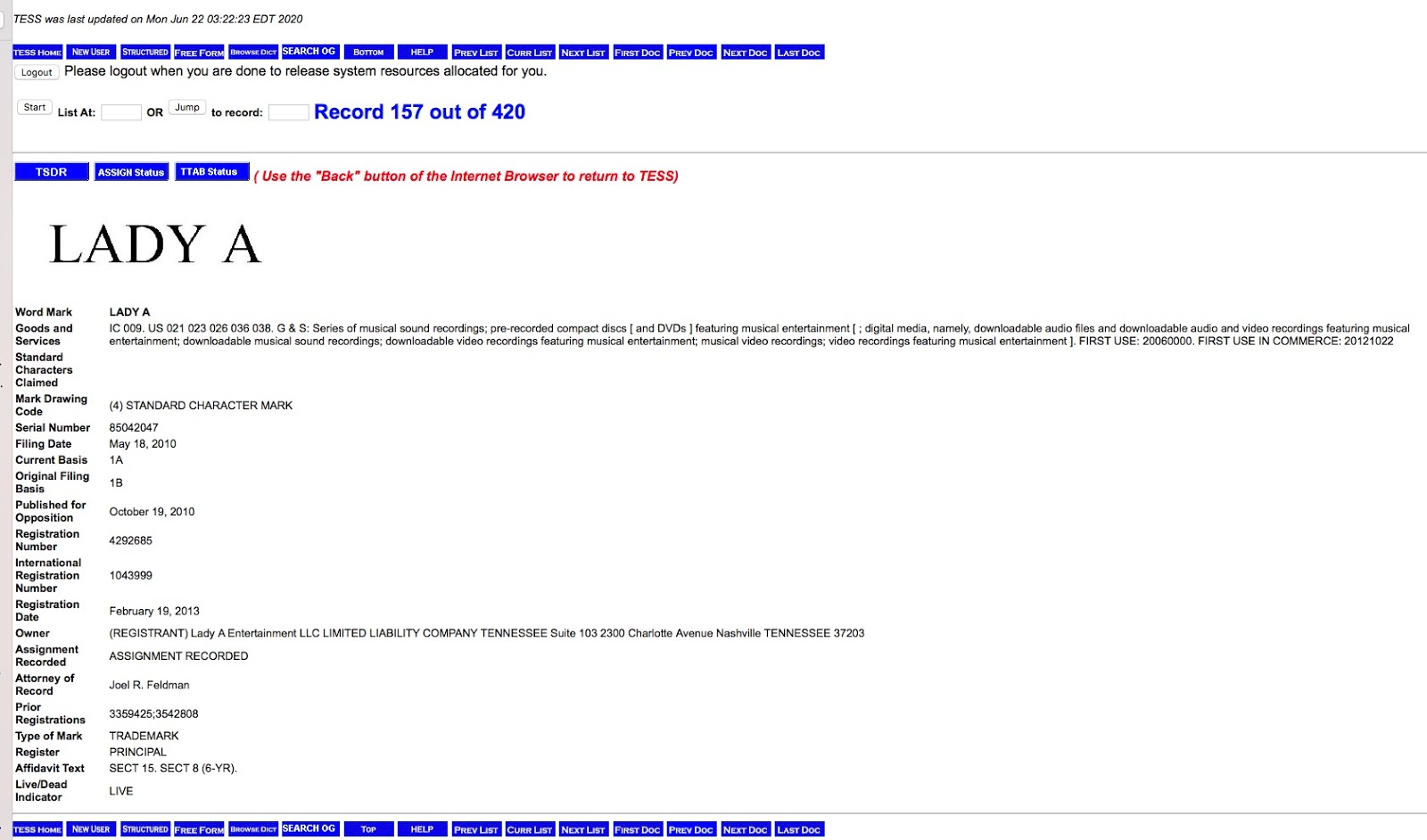
 The only real problem with this is that "Lady A" is also the professional name of a Seattle based blues singer whose real name is Anita White and who has used the name for two decades.  It would seem that a quick Google search would have revealed this troubling fact.  But the plot thickens.  A search of the Patent and Trademark Office records  reveals that the band's corporate entity, Lady A Entertainment LLC (which itself was created on August 30, 2010) owns trademark registrations for the "Lady A" mark going back to 2010 and 2013.  In other words, while the Tennessee trio might not have known about Seattle's Lady A, they conceivably had a good faith belief that they could use the name since they had several registered trademarks in the name going back a decade.

 It is not clear what will happen with Lady A and Lady A.  It looks as if after an exchange of angry words, the parties have somehow agreed to co-exist but this does bring to mind the pitfalls of dealing with trademarks in group names.  Back in the dark ages when I was in law school, we learned that it is  possible to have specific geographical limitations to trademarks,  but that seems to be a quaint notion in the Internet age.  The Trademark Office  does allow owners to co-exist with and allow others to use marks for certain limited purposes, so presumably, that is what will happen here.  I don't think that this is a battle that either Lady A or Lady A wish to fight. There don’t seem to be any great options.

Thursday, April 2, 2020

Check In

To My Clients:

I wanted to take this opportunity to check in with you during this unprecedented time.  Please know that (despite the challenges of being without power for a week early in March due to the tornado) my office is open and I am available to assist you in any way that I can.


These are strange times. People are asking questions about contracts, leases, employment issues, etc. Whatever questions you might have, just let me know.   I may be able to answer your questions outside my areas of specialization. If I don't have the answer, I will try to find out for you.


Again, if I can assist you in any way during this time, please let me know.

All the best, 


Sawnie R. (Trip) Aldredge

Thursday, January 30, 2020

Royalty Statements

            Anybody who has spent anytime at all working with artists and songwriters will have, at one point or another, tried to review  a royalty statement.  For the longest time, these were multi page documents, often impossible to decipher (sometimes intentionally).  It was (and is) important to review these documents carefully because most contracts only give a relatively short amount of time to object to incorrect accounting information.  For example, I once
had a client who had a top 10 single, which wasn't being reported by his publisher because the information had been keyed in incorrectly.  Luckily, that was easy to correct but I would worry if we had waited longer than the objection period in the agreement to  bring this up.

            Today I would  guess that most of this information is being transmitted electronically and I don't know how carefully it is being scrutinized.  These statements are also much less interesting in these days of streaming when countless lines of reporting are being used to tally pennies of income.
 
            This is why it was so intriguing to come upon these pages of royalty statements intended for the songwriters John Lennon and Paul McCartney from Northern Songs in late 1970.  Like so much Beatles ephemera, these pages ended up on an online auction site, but it is fascinating to see the reported earnings for songs like "The Word," "And Your Bird Can Sing," and "It's Only Love" and see references to those exotic foreign  entities such as Toshiba, Leeds Holland, Odeon and Sonora Sweden.  The whole world of international sub publishing was fascinating at that time.  I love this stuff.  It’s a view to history and a reminder that, as old publishers used to say,  music publishing  truly is a penny business.  

Thursday, December 5, 2019

Obama, Higher Ground and the Patent and Trademark Office

Everybody has problems with the Patent and Trademark Office. Even former President Barack Obama has problems with the Patent and Trademark Office.  I read an interesting story recently about how the former president and his wife, Michelle are setting up an entertainment production company.  In the course of organizing the new venture, Higher Ground Productions, they attempted to register a federal trademark for the name Higher Ground Productions.  The Trademark Office refused registration because of an earlier registration for a company known as "Higher Ground Enterprises" owned by Hanisya Massey.

The Trademark Office routinely rejects trademark applications when the examiner believes the marks are too similar and could cause confusion in the marketplace.  This can be extremely frustrating to the trademark practitioner because you cannot always predict when the Trademark Office is going to determine that marks are too similar – often their reasoning is unclear.  But there is no denying that "Higher Ground Productions" and "Higher Ground Enterprises" are pretty darn similar.

There has been some pretty funny reporting on the saga as the parties attempted to negotiate some kind of settlement.  According to the New York Times, at one point Massey requested screen rolls in some of the Obama's forthcoming productions.  However, the dispute appears to have become ugly with the Obamas now seeking cancellation of Massey's trademark on technical grounds based on alleged non–use.  This can occur when a trademark owner can be shown not to be actively using a mark. However,  in my experience there's a pretty low threshold needed in order to prove continued  use. 

 Maybe the Obamas just like the Stevie Wonder song-- but perhaps they should contemplate coming up with a new name…

Tuesday, November 19, 2019

Gimme Some Lovin'

            Sometimes I am  oblivious to the battles being fought by giants in my  own backyard.  I have just  aware of a case that was disposed of in the Middle District of Tennessee involving Willa Dean Parker and the widow of Homer Banks suing, among others, Stevie Winwood, his brother, Muff Winwood (real name "Mervyn" – who knew?) and Spenser Davis over the alleged copyright infringement of the song "Ain't That a Lot of Love" by the Spenser Davis Group's "Gimme Some Lovin".  There are a number of side issues in this case, as there often are, but the facts boil down to the following:

            1.         Willa Dean Parker and Homer Banks wrote "Ain't That a Lot of Love" in 1965.

            2.         The Spenser Davis Group created "Gimme Some Lovin" on April 5, 1966, and began recording it on June 9, 1966. And released it on October 28, 1966. 

            3.         “Ain't That a Lot of Love” was first released in the United Kingdom by Homer Banks on October 7, 1966 (prior to the famous Sam and Dave version). Sam and Dave did not release their version of the song until 1968. 

            In order to prove copyright infringement of a musical composition, the burden is on the Plaintiff to prove that the Defendant had "access" to the work and that the two works are "substantially similar" enough to prove that the second work was copied from the first work.  In this case, access seemed impossible to prove, since the Sam and Dave recording had not been released in England at the time the Spenser Davis Group created their iconic song.

            It seems that Parker and Banks tried to circumvent this by proving that there was an earlier version of the song by David Porter which could have been heard in the United Kingdom.  They also tried to introduce newspaper interviews by Spencer Davis, himself, where he allegedly admitted that "Gimme Some Lovin" was based on "Ain't That A Lot of Love".  The court rejected the articles as inadmissible hearsay ("a statement, other than one made by the declarant while testifying at the trial or hearing offered in evidence to prove the truth of the matter asserted").  Hence, with no proof of access , the Plaintiff's case was thrown out.  There were other fascinating aspects of the case, - like the fact that Universal Music Group was sued as a Defendant, yet it actually had partial ownership of both songs in question and, hence, could not be sued for infringement under settled copyright law.

            It's kind of a strange thing.  I listen to the famous Sam and Dave recording of "Ain't That a Lot of Love" (as well as the Webb Wilder version) and don’t hear any real similarity to "Gimme Some Lovin".  Then I listen to the Homer Banks' version and the famous riff is, in fact, nearly identical. I couldn't find the David Porter version of the song, but Taj Mahal's recording from 1968 utilizes the riff as well.  I don’t know if experts were used in this case to prove that the riff itself could have come from an earlier source, as is often the case.

            The part that I find sad is that this  battle was taking place in 2017, 51 years after the records were first released.  It reminds me of the dispute between the Estate of Randy California and Led Zeppelin over the song "Taurus".  Why didn't the writers take action when the songs were new?  In my cynical moments, I wonder if this is what has become of the music industry and that these type of lawsuits will continue until we have no surviving songwriters of the rock era, just estates suing other estates over ancient riffs. 

Wednesday, October 2, 2019

Come Together: John Lennon and Morris Levy

The 50th anniversary of the release of Abbey Road got me thinking about the most bizarre Beatles related legal battle:  John Lennon's multilayered dispute with the infamous Morris Levy.  Levy was the colorful  and shady music business kingpin whose empire included Roulette Records, the Strawberries Records chain, nightclubs and numerous other enterprises. He was eventually convicted of extortion but was able to escape prison by dying.

 Abbey Road of course starts with Lennon's composition "Come Together," which features the line, "Here come old flat top, he come grooving up slowly".  Levy's publishing company Big 7 Music sued the Beatles' publishing company and Apple Records claiming that the song infringed upon the Chuck Berry classic "You Can't Catch Me," (which contains the line "Here comes a flat top, he was moving up slowly").  Morris Levy had obtained the copyright to the Chuck Berry composition from Alan Freed.  The lawsuit was apparently prepared for trial, witnesses deposed, experts hired, etc. when Lennon and Levy arrived at an ingenious settlement of the case.  Levy would agree to drop the suit if Lennon would  record "You Can't Catch Me," along with two other Big 7 songs for his next album. 

 The idea must have seemed simple to Lennon because he was planning to make his next album a record of covers of great rock and roll songs.  Levy's catalog contained a number of such classics including Lee Dorsey's "Ya Ya" and "Angel Baby" both of which Lennon pledged to record.  Beatle fans know that nothing is simple and it didn't really happen like this.  

 In what should truly become a feature film,  Lennon began the sessions for this album "Rock and Roll" with Phil Spector and there were reports of drug and alcohol fueled drama complete with Spector firing a gun in the studio (a bit of horrific foreshadowing).  Very little was accomplished before Spector abandoned the sessions and absconded with the master tapes.  While Lennon's representatives negotiated with Spector for the return of the tapes Lennon produced an album for Harry Nilsson  and completed his own Walls and Bridges, on which he recorded a charming but insignificant version of "Ya Ya" with his son Julian.  

Apparently Lennon decided to try and salvage the Spector tapes and record additional material for the album in New York.  Because Lennon had technically breached the settlement agreement by not releasing these recordings on his "next" album Levy became a constant presence in his life, flying him, May Pang and Julian to Disney World, taking him and his band to his farm in upstate New York to rehearse and somewhere along the line Levy got the idea that Lennon had given  him the right to sell the forthcoming record through television mail order advertising ("operators are standing by") on his ADAM VII label.  The facts are befuddling and common sense would indicate to  any rational person that the Beatles' exclusive agreement with EMI would prohibit a third party from releasing  any solo Beatle recordings but Morris Levy was not any typical record company owner.  Apparently Allen  Klein is involved in the story too and may have added fuel to the fire.  Unbelievably, Morris Levy took a rough mix of the recordings which Lennon had given him, slapped an out of date 1968 photograph of Lennon on the cover and began selling Roots:  John Lennon Sings the Great Rock and Roll Hits.  This of course to led to Capitol Records rush  releasing the Rock and Roll album,  Capitol and Lennon both suing Levy and Levy suing Capitol, Lennon and everybody else he could think of.  The reporting of the trial, brilliantly captured in Stan Soocher's book Baby You're  A Rich Man:  Suing the Beatles for Fun and Profit is fascinating, showing a side to Lennon rarely captured.  At the end of it all, the trial judge ruled that Lennon had in fact breached his original settlement agreement with Levy by not releasing "Angel Baby"  (it was posthumously released) but Levy  was enjoined from distributing  Roots,  Lennon was awarded damages for Levy's damage to his reputation from releasing substandard product and Capitol Records was awarded damages for lost profits.  

The Roots album has gone on to become one of the holy grails of Beatles collecting.  Originals are hard to find although counterfeit copies are somewhat easier to locate.  


The irony of all this is that I don’t think Levy would have prevailed in his original  lawsuit. Although the statutory defense to infringement known as  fair use was not codified as a at the time of the original 1970 litigation (it was added in the Copyright Act of 1976) it was still a viable defense and one could argue that Lennon's quote of a single line from a Chuck Berry song in his  song "Come Together" was not in fact copyright infringement.  Most of the case law (at least the case law prior to the "Blurred Lines" decision and the recent Katy Perry decision) would tend to support this theory.  On the other hand, Lennon's idea to simply record a handful of Levy songs to make the lawsuit go away makes a lot of sense.  Perhaps he was also thinking about what his former band mate George Harrison was about to endure with the "My Sweet Lord/He's So Fine" litigation.  But those are different songs and different stories.  


Thursday, June 20, 2019

For Those Wondering if They're Really Married

If there was any doubt before, it's now official.  It has been a custom for years for marrying couples to ask a friend to perform the ceremony for them.  I myself performed a number of marriages by becoming a "special judge" for the day.  I think the most common method though has been for the officiant to become a Universal Life Minister, or to be "ordained" by a similar entity.

            For years, the Tennessee statute on marriage has said that marriages may be performed by "all regular ministers, preachers, pastors, priests, rabbis and other spiritual leaders of every religious belief, more than 18 years of age, having the care of souls…" and "(2) in order to solemnize the rite  of matrimony, any such minister, preacher, pastor, priest, rabbi or other spiritual leader must be ordained or otherwise designated in conformity with the customs of a church, temple or other religious group or organization; and such customs must provide for such ordination or designation by a considered, deliberate, and responsible act."

            An opinion from the Tennessee Attorney General theorized that someone who becomes a minister online cannot be doing so by a "considered deliberate and responsible act", thereby throwing the legitimacy of online officiants into question However, until  recently this wasn't an issue; county clerks did not question the authority of the person signing the marriage license and presumably the only time this issue might come up would be in a divorce proceeding (i.e. where one party would argue that there was no valid marriage). 

            The new amendment to the law adds a section stating that "persons receiving online ordination may not solemnize the right of matrimony".  The question appears to be settled although I have read that groups are attacking the new law and it will probably end up in court at some point.  

            The biggest issue that people were concerned about was the question of whether their own marriages performed by a Universal Life Minister were valid.  The law gives some certainty in this area by stating that "if a marriage has been entered into by license issued pursuant to this chapter in whichanyminister officiated before July 1, 2019, the marriage must not be invalid because the requirements…have not been met".  This should cause some relief to those people wondering if they were legally  married.

Friday, June 7, 2019

More Aretha- Holographic Wills


It seems that I spoke too soon when I wrote my blog about Aretha Franklin dying without a will.  (http://tripaldredgelaw.blogspot.com/2018/11/aretha-prince-and-simple-need-for.html). According to the New York Times she had three wills – or as the reporters described the documents "the scrawled papers which are dated between 2010 and 2014, are at times barely legible, with cross‑outs, marginal notes and some salty tangents".

Apparently two of Ms. Franklin's sons oppose entering the documents as wills in the probate proceeding.  I am not exactly sure why but it appears that in one of the documents she treated her oldest son Clarence differently than her other three children, which may or may not be because he has some sort of special needs.  The article stated that the final document  drafted in 2014 divided the estate between her children and grandchildren.  If  Franklin were to be determined to have died intestate, then the estate would be equally divided between the four sons.  Michigan (where Ms. Franklin resided at the time of her death) appears to have a holographic will statute similar to the statute we have in Tennessee – which provides that if the document is written entirelyin the testator's handwriting and signed by the testator and expresses an intent to operate as a will – it should generally be admissible.

The important point here is that a holographic will is perfectly legal but it must be written entirely in the testator's own hand (i.e. not typed and then signed) – this is a mistake many people make.  Also there must be a witness available who can identify the deceased's handwriting.

The court in Michigan is going to hold a hearing sometime this month to evaluate the new documents.  Whatever the outcome, it's nice to see that Aretha will probably have the last word. 


Tuesday, May 28, 2019

The Virtues

On the advice of someone I greatly respect, I just finished reading Benjamin Franklin’s Autobiography. It’s a short but fascinating book which I should have read years ago, On the negative side, Franklin must have been the nation’s first self-promoter and he controlled  the media of his time. He was also a racist and something of a misogynist. On the other hand, his clarity of vision, industry and self-motivation are as compelling today as they were nearly three centuries ago. 
I was struck by the fact that Franklin conceived of “The Virtues” as a kind of blueprint for living a good life. He carefully perfected and studied this list and then tried to work on one of the items every day. In that sense, besides his other inventions, Franklin probably created the self-improvement book genre. He was the Tony Robbins of the eighteenth century. Nonetheless, I found this list rewarding and I thought that it might be an interesting exercise to reproduce it here. Thus, here are Benjamin Franklin’s virtues:


THE VIRTUES

            1.         Temperance

            Eat not to dullness; drink not to elevation.

            2.         Silence

            Speak not but what may benefit others or yourself; avoid trifling conversation.

            3.         Order

            Let all your things have their places; let each part of your business have its time.

            4.         Resolution

            Resolve to perform what you ought; perform without fail what you resolve.

            5.         Frugality

            Make no expense but to do good to others or yourself; i.e., waste nothing.

            6.         Industry

            Lose no time; be always employed in something useful; cut off all unnecessary actions.

            7.         Sincerity

            Use no hurtful deceit; think innocently and justly, and, if you speak, speak accordingly.

            8.         Justice

            Wrong none by doing injuries, or omitting the benefits that are your duty.

            9.         Moderation

            Avoid extremes; forbear resenting injuries so much as you think they deserve.

            10.      Cleanliness

            Tolerate no uncleanliness in bodies, clothes or habitation.

            11.      Tranquility

            Be not disturbed at trifles, or at accidents common or unavoidable.

            12.      Chastity

            Rarely use venery[1]but for health or offspring, never to dullness, weakness or injury of your own or another's peace or reputation.

            13.      Humility

            Imitate Jesus and Socrates.


[1]I had to look this one up.